> For the complete documentation index, see [llms.txt](https://docs.payfacto.com/payfacto-knowledge/llms.txt). Markdown versions of documentation pages are available by appending `.md` to page URLs; this page is available as [Markdown](https://docs.payfacto.com/payfacto-knowledge/canada-doc-center/applications/secure-payment/app-to-app-module-user-guide/tasks-and-how-tos/transaction-workflow.md).
# Transaction Workflow
This section describes the general transaction workflow and user experience when making a purchase with a merchant using the Secure Payment application's App to app module.
### Payment Process Begins
The merchant will calculate the total amount using a Point of Sale (POS) system or a cash register and enter the total amount on the payment terminal using the third-party application. The third-party application then communicates the total amount to the Secure Payment application's App to app module.
{% hint style="info" %}
NOTE: Due to the variety of third-party payment applications, no image of this step in the workflow process is included in the documentation.
{% endhint %}
The next step in the process depends on the type of sale. If the merchant adds any surcharge for debit card transactions (for Canadian merchants only, excluding Quebec), the App to app module applies the associated surcharge to the total amount and requires the customer to confirm the total.
The following sections will describe the workflow without surcharges; the available sale types are:
* [Sale Without Tip](#sale-without-tip)
* [Sale With Tip](#sale-with-tip)
* [Debit sale with cashback](#debit-sale-with-cashback)
***
### Sale Without Tip
After the merchant enters the amount on the third-party application, the Secure Payment App to app module displays the total sale amount, at which point the merchant hands the terminal to (or turns it towards) the customer.
1. The customer inserts, swipes, or taps their payment card.
2. The terminal displays a processing screen with the payment card brand logo.
3. After approving (or declining) the payment request, the terminal prints the merchant copy of the transaction receipt and the merchant touches **Print receipt** to print the customer copy or **No receipt** if the customer does not want their copy of the transaction receipt.
***
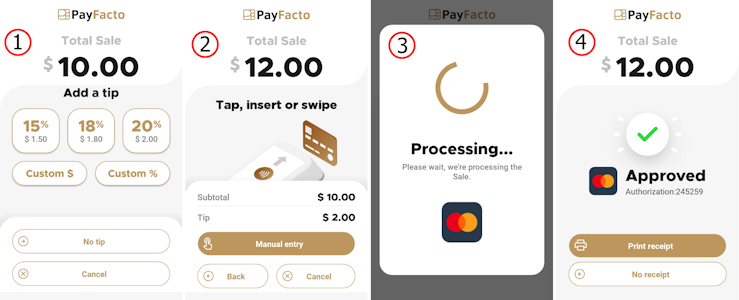
### Sale With Tip
After the merchant enters the amount on the third-party application, the Secure Payment App to app module displays the *Add a tip* screen, at which point the merchant hands the terminal to (or turns it towards) the customer.
1. The customer selects one of the preset tip percentages, a custom dollar amount, or a custom percentage (if enabled) or they can touch the **No tip** button.
2. After the customer selects the tip amount, the *Total Sale* screen appears where the customer then inserts, swipes, or taps their payment card.
3. The terminal displays a processing screen with the payment card brand logo.
4. After approving (or declining) the payment request, the terminal prints the merchant copy of the transaction receipt and the merchant touches **Print receipt** to print the customer copy or **No receipt** if the customer does not want their copy of the transaction receipt.
***
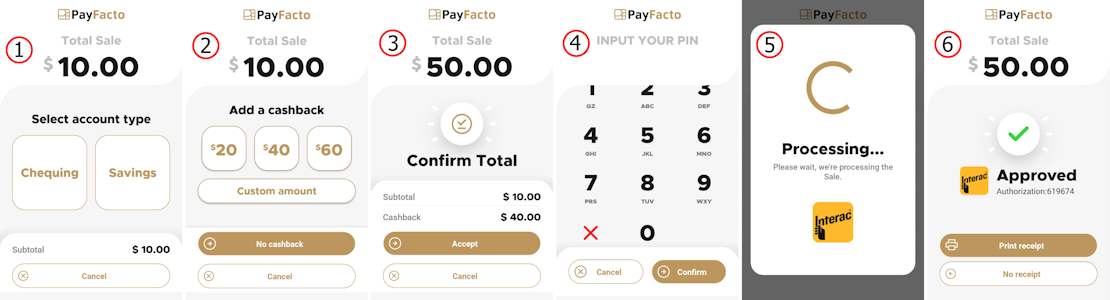
### Debit Sale with Cashback
{% hint style="warning" %}
IMPORTANT! Cashback is only available for debit transactions where clients **insert their card into the terminal and enter their PIN**. If a client taps a contactless card, the cashback option will not appear.
{% endhint %}
After the merchant enters the amount on the third-party application, the Secure Payment App to app module displays the total sale amount, at which point the merchant hands the terminal to (or turns it towards) the customer. If the sale includes a tip, the terminal displays the *Add a tip* screen, where the customer selects the tip to add (or not) before inserting the card into the terminal's chip reader.
1. The customer selects the account to debit the sale amount from (**Chequing** or **Savings**).
2. The customer selects the amount for cashback.
3. The customer confirms the total amount (sale plus cashback).
4. The customer enters their PIN and touches the **Confirm** button.
5. The terminal displays a processing screen with the payment card brand logo.
6. After approving (or declining) the payment request, the terminal prints the merchant copy of the transaction receipt and the merchant touches **Print receipt** to print the customer copy or **No receipt** if the customer does not want their copy of the transaction receipt.
---
# Agent Instructions
This documentation is published with GitBook. GitBook is the documentation platform designed so that both humans and AI agents can read, navigate, and reason over technical content effectively. Learn more at gitbook.com.
## Querying This Documentation
If you need additional information that is not directly available in this page, you can query the documentation by asking a question.
Perform an HTTP GET request on the following URL with the `ask` and `goal` query parameters:
```
GET https://docs.payfacto.com/payfacto-knowledge/canada-doc-center/applications/secure-payment/app-to-app-module-user-guide/tasks-and-how-tos/transaction-workflow.md?ask=&goal=
```
`ask` is the immediate question: it should be specific, self-contained, and written in natural language.
`goal` is what the user is ultimately trying to achieve, the reason they need the answer. Sharing it helps GitBook give you a better, more relevant answer. A goal is most helpful when it describes the outcome the user wants rather than restating the question. For example, with `ask=how do I create an API token`, a goal like `automate deployments from our CI pipeline` lets GitBook tailor the answer to that use case.
The response will contain a direct answer to the question and relevant excerpts and sources from the documentation.
Use this mechanism when the answer is not explicitly present in the current page, you need clarification or additional context, or you want to retrieve related documentation sections.