> For the complete documentation index, see [llms.txt](https://docs.payfacto.com/payfacto-knowledge/llms.txt). Markdown versions of documentation pages are available by appending `.md` to page URLs; this page is available as [Markdown](https://docs.payfacto.com/payfacto-knowledge/veloce-pos/veloce/veloce-back-office/introduction/basic-navigation.md).
# Basic Navigation
After logging in, the Main Back-Office is displayed. This is the main screen that allows access to all the Veloce features.
The blue icons around the Veloce logo are all the modules that are current available with the purchased license. In the image below, all modules are available. If a customer doesn't need all modules for their operation, only the modules they purchased would be displayed.

***
### Opening modules
Clicking on a module icon opens the corresponding module in a separate window:

The same result can be achieved by clicking the Selector menu and selecting the desired module name:

***
### Multi-Instances
Each module can be opened in multiple instances. This is useful for working simultaneously on different elements within a module.

However, be careful as opening too many instances could become quite overwhelming:

***
### Closing modules or the Main Back-Office screen.
The main Back-Office as well as each module can be closed by clicking the blue Quit button, the "X" in the upper-right corner of the window, or using the File menu and selecting the Quit option.

{% hint style="warning" %}
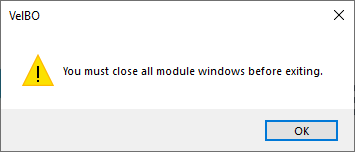
IMPORTANT! Before closing the Main Back-Office, all other modules need to be closed. Otherwise, an error message will be displayed:
{% endhint %}
***
### Exit to password

The Exit to password icon is used to close the Main Back-Office window and bring up the login screen, which allows another user to log in.
As with the regular "Quit" options, all other module windows need to be closed, otherwise an error message with be displayed.
---
# Agent Instructions
This documentation is published with GitBook. GitBook is the documentation platform designed so that both humans and AI agents can read, navigate, and reason over technical content effectively. Learn more at gitbook.com.
## Querying This Documentation
If you need additional information that is not directly available in this page, you can query the documentation by asking a question.
Perform an HTTP GET request on the following URL with the `ask` and `goal` query parameters:
```
GET https://docs.payfacto.com/payfacto-knowledge/veloce-pos/veloce/veloce-back-office/introduction/basic-navigation.md?ask=&goal=
```
`ask` is the immediate question: it should be specific, self-contained, and written in natural language.
`goal` is what the user is ultimately trying to achieve, the reason they need the answer. Sharing it helps GitBook give you a better, more relevant answer. A goal is most helpful when it describes the outcome the user wants rather than restating the question. For example, with `ask=how do I create an API token`, a goal like `automate deployments from our CI pipeline` lets GitBook tailor the answer to that use case.
The response will contain a direct answer to the question and relevant excerpts and sources from the documentation.
Use this mechanism when the answer is not explicitly present in the current page, you need clarification or additional context, or you want to retrieve related documentation sections.